The short answer
The Thailand DTV visa (Destination Thailand Visa) is a five-year visa for remote workers, freelancers and people who come to Thailand for activities like Muay Thai or cooking classes. You apply through the Thai e-visa system and a Thai embassy or consulate. The fee is $400 at the Royal Thai Embassy in Washington, DC. The Thailand DTV visa requirements changed on August 31, 2026: you now need proof of permanent residence and a criminal record certificate.
Who can get the DTV visa
The Thai embassy in Washington, DC lists two groups. The first is remote work. That covers digital nomads, freelancers and foreign talent. The second is people who take part in Thai "soft power" activities, such as Muay Thai, culinary training and medical treatment.
Your spouse and your children under 20 can apply too. Each person needs their own application.
What changed on August 31, 2026
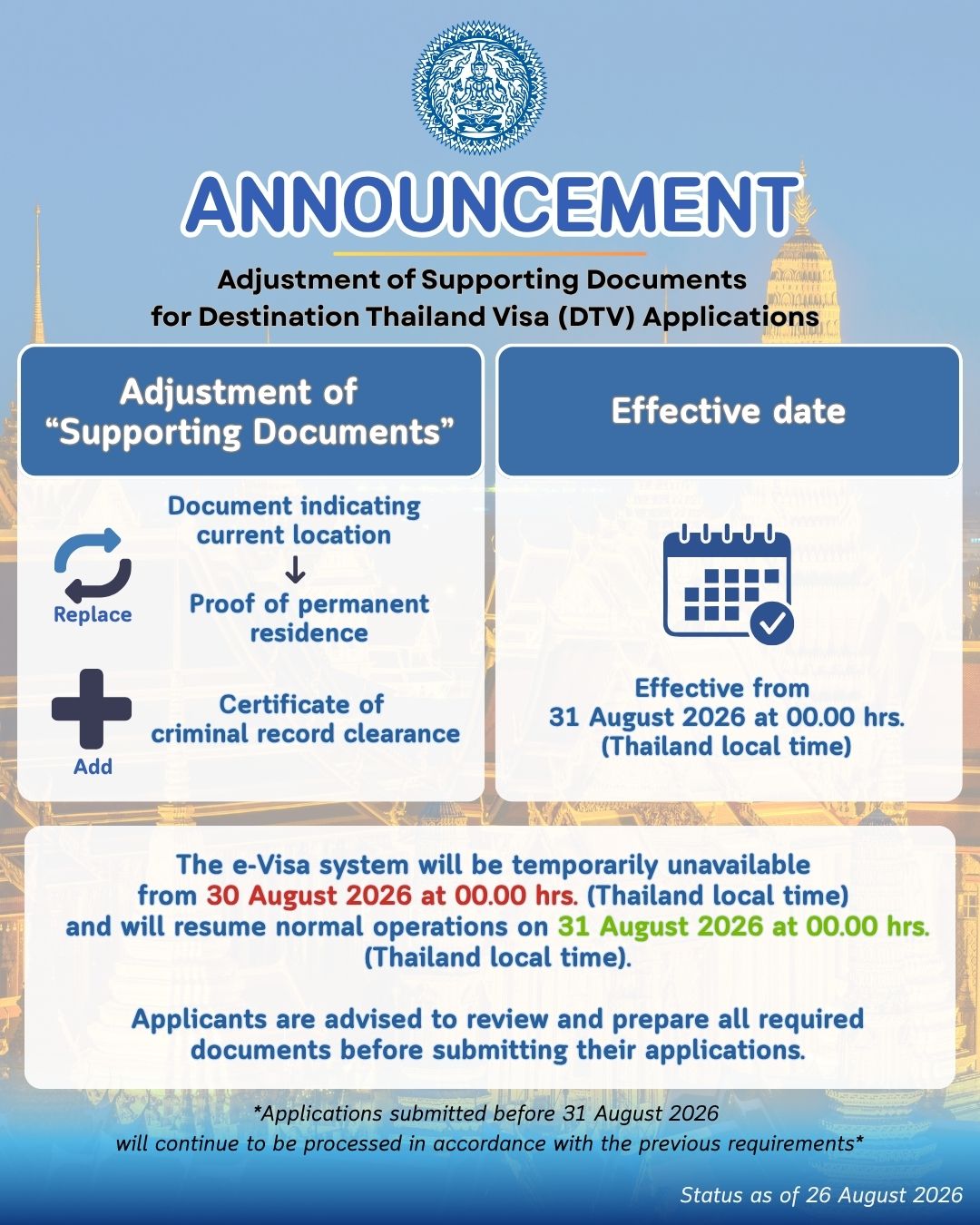
The Thai Ministry of Foreign Affairs posted an update with two edits to the document list. It took effect on August 31, 2026 at 00:00 Thailand time.
- "Proof of permanent residence" replaced "document indicating current location".
- A criminal record clearance certificate was added.
- Applications submitted before August 31 are still processed under the old rules.
This matters because many guides and videos are older. They tell you a lease, a utility bill or a hotel booking proves where you are. That advice is out of date for new applications.
One more catch: the DC embassy page still lists the old location document next to the new one. Follow the new rule and ask your mission if you are unsure.
Thailand DTV visa requirements: documents for US citizens
Each Thai mission posts its own list. This one comes from the DC embassy and the Los Angeles consulate.
- Passport. The DC embassy lists six months of validity. Check the exact wording on your mission's page.
- Photo. It must be taken within the last 6 months.
- Bank statements. The DC embassy asks for an ending balance of at least 500,000 baht (about $16,000) for each month. The LA consulate asks for the last 3 months.
- Proof of work. Send an employment contract or an employment certificate. If you freelance, send a portfolio of your work.
- Proof of permanent residence. The DC embassy lists a valid US visa or a permanent resident card. The LA consulate also lists a driver's license among its examples. Ask your mission which one it accepts for you.
- FBI certificate. It must be issued within 3 months of your application.
For soft power activities, you need a letter of acceptance from the school or company. Muay Thai applicants also need a letter from the Sports Authority of Thailand, according to the LA consulate.
If a document isn't in English or Thai, the DC embassy says the translation and notarization must come from the embassy or the Thai foreign ministry.
Cost and processing time
- Fee: $400 at the DC embassy. Fees vary by mission. The Ho Chi Minh City mission lists $340.
- Validity: 5 years, per the DC embassy.
- Processing time: The DC and LA DTV pages don't state one. Their general visa pages say up to 15 business days. The Ho Chi Minh City page says 5 working days.
People who posted their experience on YouTube report a wide range, from same-day approval to about six weeks. Some were asked for extra documents. All of those videos were made before August 31, and none were US missions, so treat them as a rough guide only.
Extension of stay and how long you can stay
The DC and LA pages tell you to contact the Immigration Bureau for an extension once you are in Thailand. They don't say how long each stay can be.
The Ho Chi Minh City mission lists a maximum stay of 180 days per entry, with a 180-day extension. That is one mission's page, not a US one. Confirm the stay length with your own mission before you book flights.
Where to apply
Applications go through the Thai e-visa system at thaievisa.go.th, according to the Thai embassy in Moscow. Your documents are checked by the embassy or consulate you choose.
No page we read says plainly whether a US citizen living outside the US can apply at a mission in another country. The new proof-of-residence rule suggests missions expect you to live in their area. The Ho Chi Minh City page says it accepts only residents of Viet Nam. Contact the mission before you travel to apply.
What we could not confirm
- The stay per entry and the extension rules for US applicants.
- The DTV extension fee. We found no figure on an official page we could read.
- Whether US citizens can apply from a third country.
- Which proof of permanent residence a US citizen needs. The DC and LA pages give different examples.
We will update this page when an official source answers these.
If the DTV doesn't fit
Visa-free entry (up to 30 days)
US citizens are on the 30-day visa-free list that took effect on September 15, 2026. You can ask to extend by up to 30 more days at an immigration office. The officer decides. You may be asked to show 20,000 baht in cash per person. It is for tourism only.
Tourist visa
The LA consulate lists a single-entry visa for $40, valid for 3 months, and a multiple-entry visa for $200, valid for 6 months. Each stay can last up to 60 days, with a 30-day extension possible. That page is dated October 2025.
Retirement visas
The DC embassy lists the O-A visa ($200, one year) and the O-X visa ($400, five years). Both are for people 50 and older. The money and insurance figures on those pages don't match each other, so check with the embassy before you plan around them. Read the full retirement visa guide.
The arrival card
Everyone entering Thailand needs the Thailand Digital Arrival Card, including visa-free travelers. It is free. Fill it in within 3 days before you arrive. The only official site is tdac.immigration.go.th. Thai embassies warn about paid lookalike sites.
What to sort out next
🛡️ Insurance
Plans for remote workers and long stays.
📶 eSIM
Data from the moment you land.
🏦 Money
Moving money and getting paid abroad.
Disclosure: Some links in these picks are affiliate links. They never alter what we say about visa rules.
Guides from people who did it
Questions people ask
Can US citizens apply for the Thailand DTV visa?
Yes. The Thai embassy in Washington, DC and the consulate in Los Angeles both list DTV requirements for US applicants. You apply through the Thai e-visa system and attach documents such as bank statements, proof of work, proof of permanent residence and an FBI certificate. Check your mission's page for its exact list.
How much does the Thailand DTV visa cost?
The fee is $400 at the Royal Thai Embassy in Washington, DC. Other missions set their own fees. The Ho Chi Minh City mission lists $340. Check the fee on your mission's page before you pay, since it can differ by location and currency.
How much money do you need for the DTV visa?
The DC embassy asks for bank statements with an ending balance of at least 500,000 baht, about $16,000, for each month. The LA consulate asks for the last three months of statements. You also need proof of work, such as an employment contract or a portfolio.
Do you need an FBI certificate for the DTV visa?
Yes, for applications sent from August 31, 2026. The Thai foreign ministry added a criminal record clearance certificate to the list. The DC and LA pages ask for an FBI certificate issued within 3 months. Applications sent before that date follow the old rules.
How long is the DTV visa valid?
It is valid for five years, according to the Thai embassy in Washington, DC. That page doesn't say how long each stay can last. One mission lists 180 days per stay with a 180-day extension. Confirm the stay length with your own mission before you travel.
Verdict
The Thailand DTV visa requirements are manageable if you work remotely and can show savings, proof of work, proof of residence and an FBI certificate. Start the FBI request early. Then check your mission's page for its fee and document list, since both vary.
Sources
- Royal Thai Embassy, Washington DC: DTV visa (updated Sep 10, 2026)
- Royal Thai Consulate-General, Los Angeles: DTV visa (updated Oct 1, 2026)
- Thai foreign ministry infographic: DTV document update (status as of Aug 26, 2026)
- Thai foreign ministry announcement (Aug 28, 2026)
- Royal Thai Embassy, Washington DC: visa exemption (updated Sep 17, 2026)
- Royal Thai Consulate-General, Los Angeles: tourist visa (dated Oct 2, 2025)
- Royal Thai Consulate-General, Ho Chi Minh City: DTV
- Royal Thai Embassy, Moscow: DTV document update (Sep 2, 2026)
- Royal Thai Embassy, Canberra: arrival card notice (Nov 24, 2025)
Visa rules shift often. We checked these pages on October 15, 2026. Confirm with the embassy or consulate that handles your application before you travel.